
If a peripheral thrombectomy aspiration catheter is described online as only “a catheter,” visitors will miss its real clinical position. Based on public Indigo-system references, published reviews on catheter-based thrombus removal, and your current brochure assets, the stronger way to present this product is as a system built around clot-burden removal, sustained aspiration, and procedural continuity.
1. Start from the disease and treatment context
This category is not really about replacing one catheter with another. It sits in thrombus-burden reduction scenarios, where the clinical objective is often to restore flow quickly, reduce symptoms, and create a better procedural path for further endovascular treatment when appropriate.
Public reviews of lower-extremity DVT and peripheral thrombus intervention repeatedly describe several practical goals:
- reduce thrombus burden more directly
- help restore venous or arterial flow
- create a procedural pathway for further lesion treatment
- improve continuity during intervention compared with a purely passive approach
That is why the website should clearly use terms such as DVT, VTE, peripheral thrombus aspiration, and clot-burden removal, instead of leaving the product as a device name without context.
2. The better product story is a system, not a single catheter
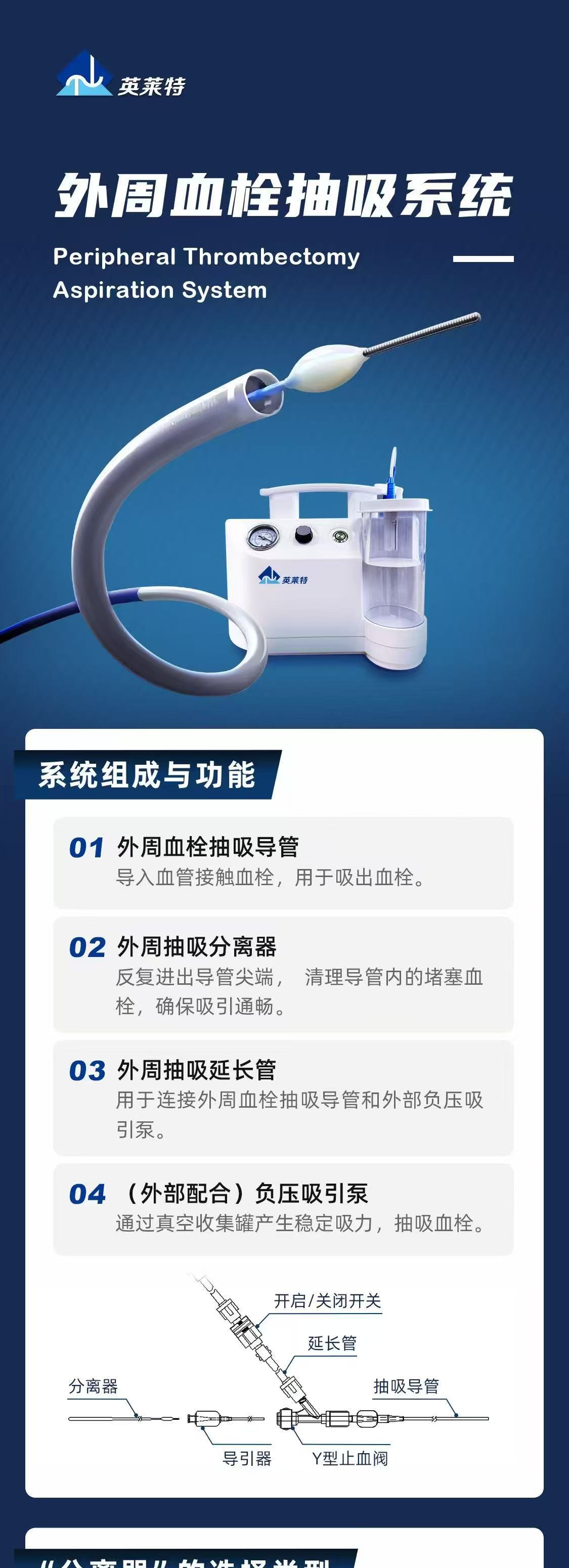
Public references around Indigo and similar platforms do not frame the therapy as “just a catheter.” They frame it as a coordinated aspiration system. Your brochure already supports the same logic, so the website should organize the product around three elements:
-
Aspiration catheter
The working component that reaches the target vessel and removes thrombus burden. -
Peripheral aspiration separator
A key accessory that helps maintain or restore catheter patency during aspiration. -
Control system / vacuum support unit
The component that provides sustained aspiration support and turns the therapy into a stable workflow rather than a simple manual maneuver.
For that reason, the website should describe the product as:
“a peripheral thrombectomy aspiration catheter system composed of aspiration catheter, peripheral separator, and control support.”
3. The separator matters because the system has to keep working
This is one of the most important pieces to explain well.
In real thrombus-removal workflows, aspiration is not always a one-step action. When thrombus burden is large, the catheter may lose efficiency or face clogging risk. That is where separator logic becomes clinically meaningful. It is not just an accessory; it supports the system’s ability to keep functioning through the procedure.
That makes the product easier to understand in four linked steps:
- the catheter removes thrombus burden
- the separator helps maintain or restore patency
- the control system provides continuous negative-pressure support
- together they aim to improve aspiration efficiency and procedural continuity
That explanation is much more useful than simply listing the separator as a component.
4. Specifications and pairings are what serious users look for next
Another important characteristic of this product class is that it is platform-based. Your brochure already shows pairing logic such as ACT 8, ACT 10, and ACT 12, together with catheter specifications and accessory information. For users, that answers practical questions such as:
- which model fits which case
- how separator and catheter are paired
- what platform options relate to vessel pathway and clot burden
- what has to be prepared before the procedure
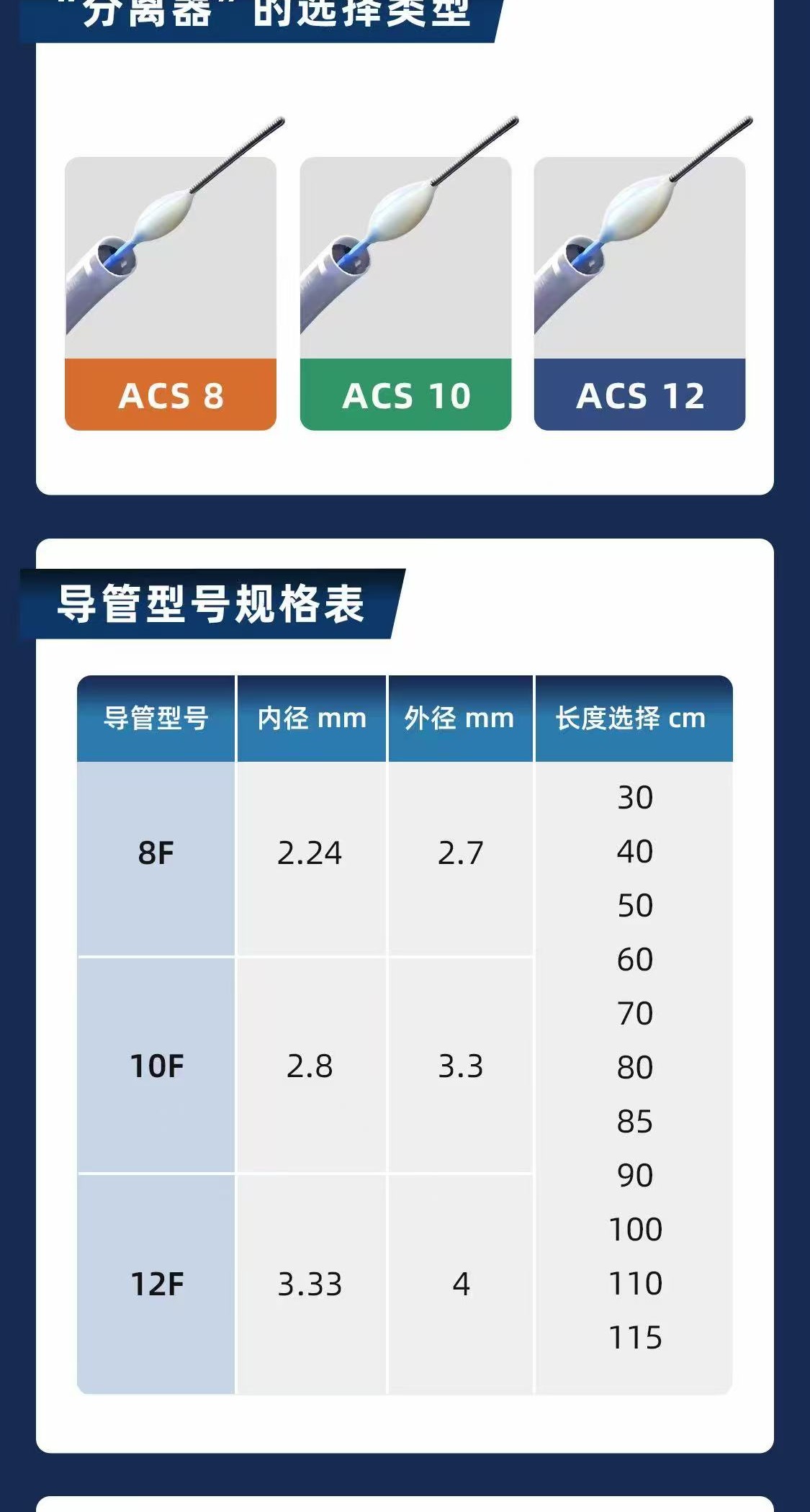
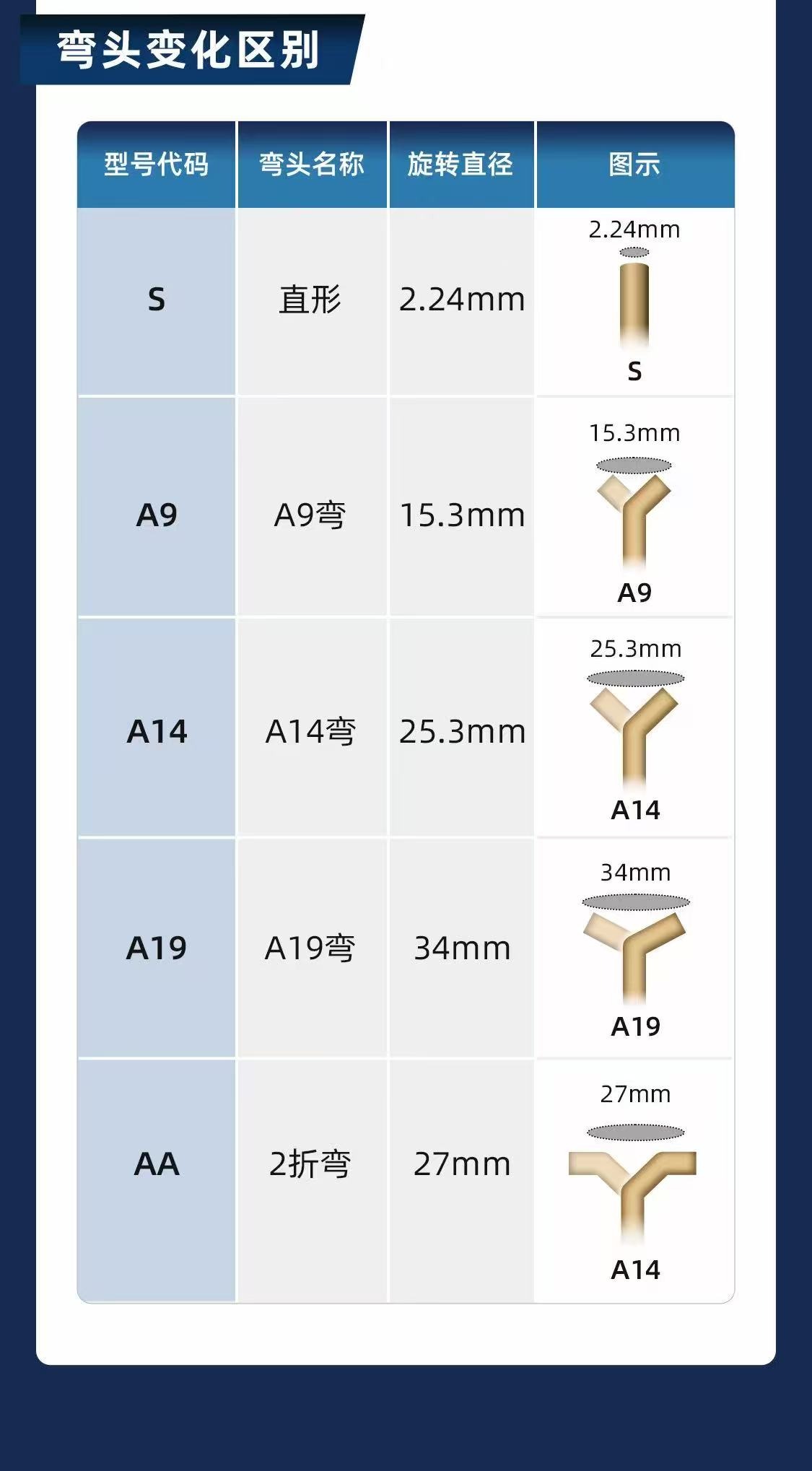
This is why a dedicated Specifications & Pairing module is not optional on the website. It is a conversion-critical block for physicians, distributors, and partners.
5. How the website should present it in a professional but careful way
For a medical-device website, the best version of this article is not one that overclaims clinical outcomes. It is one that clearly answers:
What problem does it address
Peripheral thrombus-burden removal scenarios where a direct aspiration workflow is valuable.
Why is it a system
Because catheter, separator, and control support work together rather than as isolated parts.
What is the real differentiator
The separator helps preserve or restore catheter patency, so the system is designed not only to aspirate, but to keep aspirating.
What will a serious visitor want next
Specifications, model pairings, accessory logic, and a clear materials-request path.
6. What this means for future website content
If this becomes a long-term product line, the website can expand around:
- clinical overviews of peripheral thrombus-burden removal
- DVT / VTE education content
- relationship between aspiration systems and other intervention-access products
- model-by-model guidance and platform differences
That will help the product page, brochure assets, and insight articles reinforce one another over time.
References
These references are included to support industry-level interpretation. Final indications, intended use, and procedural boundaries should always follow formal registration materials and IFU documents.
- Penumbra. Peripheral Thrombectomy / CAVT Platform.
https://www.penumbrainc.com/products/peripheral-thrombectomy-cavt/ - Penumbra. Indigo System Family Brochure.
https://www.penumbrainc.com/wp-content/uploads/2018/03/10013E_Indigo_System_Family_Trifold_Brochure_USA_.pdf - Catheter-Directed Interventions for the Treatment of Lower Extremity Deep Vein Thrombosis.
https://pmc.ncbi.nlm.nih.gov/articles/PMC9783165/ - Interventional Procedures in Deep Venous Thrombosis Treatment: A Review of Techniques, Outcomes, and Patient Selection.
https://pubmed.ncbi.nlm.nih.gov/40870521/